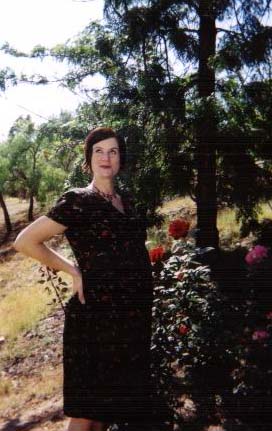
 |
Zoë in April, 2002, |
 |
Zoë in August 2002, |
 |
Zoë in October, 2002, |
OLD MAN, NEW BABY -- San Diego Reader, October 2002
It could be a gender
difference, or an individual one. All I know is that I never thought much about
having kids until I had one. Laura, my wife at the time, thought about the
future more than I did, and she wanted kids in her future. So when it wasn’t
happening, being the agreeable fellow I can be now and then, I got a simple
operation and zap.
The greatest surprise of my life has been the transformation
of my heart the day my daughter joined us in the outer world.
Back up.
I’d been a sensitive, affectionate kid, as kids go, until I
hit adolescence and people started dying. My grandpa. My great grandma. My other
grandpa. Uncle Charlie. My dad. Uncle Eddie. Aunt Mary. Uncle Fenton. My other
grandma. And three high school friends including Eric.
Eric had moved in with me while my mom was hospitalized with
spinal meningitis, which caught her shortly after my dad’s fatal heart attack.
For months, they kept her in isolation, and all that time Eric stayed with me. I
suppose he wasn’t an angel, but in my many years I haven’t met anyone who
appears closer to angelhood.
Eric was wise, compassionate, true-hearted. When we were
seventeen and he died by flying out of a Volkswagen on Viejas grade above
Alpine, I took a vow. I would love nobody. Then neither death nor desertion
could hurt me.
The attitude worked, except it doomed my marriage and helped
make me crazy.
When Darcy arrived, the sight of her instantly flushed my
heart of that vow against loving. I’d sooner have risked any torment than
given up my bond with that perfect little girl.
I became a different fellow. Once you start loving, you can’t
just direct it where you please. Love has a mind of its own.
*
Our marriage was
already rocky when we decided to go for another kid. Laura wanted another and I
agreed, though a counselor we tried working with contended that until we’d
resolved our issues, another child would hardly be practical. But practicality
would rank at the bottom of my aptitude profile, just below biology and
basketball.
We were vagabonds, back then. When Darcy was two months old
we moved to Iowa for my gradual school (for a definition of "gradual"
see or read The World According to Garp, by John Irving who was my first
professor there). When Cody was two months, we moved to Arizona for a teaching
job I’d been offered. Two years later, we moved to Chico, CA for a job with
more security, which we craved on account of the little ones.
But security only exists as a craving. Even though the
college in Chico gave me tenure--so they couldn’t have fired me unless I
kidnapped the president’s daughter--I had to leave it behind because Laura and
I split apart and my kids, whom I loved more than God, more than health, the
sky, art or anything, went to live in San Diego.
I tried commuting (1000 mile weekend trips) for a while but,
feeling what I imagine was a similar emptiness to that of Mexicans who labor up
here for their families in Mexico, I chucked the best job I’ll probably ever
have and returned to San Diego.
Laura and I agreed to joint legal and physical custody (which
I don’t recommend as my kids suffered from it).
In those first years back, the times I lived for were
coaching Cody and the team during practices and ball games at Kuhlken Field,
home of La Mesa National Little League. They’d named it after my dad since he’d
been president and organized the renovation of the field. During our games,
pulling for Cody, I came to understand why a father I knew dropped dead in the
stands while his son was pitching.
As teenagers, my kids carried on the family tradition of
abject rebellion, to the degree that I wrote a Reader story about the
Tough Love group I was attending weekly.
*
The same year my kids began to climb
out of the mud, I met Pam.
A fellow named Terry and I had opened a bookstore. One
morning, after ten single years, while on my way to open the place, I allowed
myself to daydream of a woman and toy with the concept that my chance of meeting
somebody would improve if I knew the characteristics of the somebody I sought.
I listed desirable traits: Old enough so I wouldn’t get
arrested. Attractive, to me anyway. Educated, so we might commune as equals.
Artistic, so she would sympathize with my writing obsession. Of similar
spiritual beliefs, as I had recently dated two women who thought Christian
and moron were synonyms. Not very materialistic--I was almost poor. With
no more than one child, since my two teenagers pushed against the limit of what
my psychic resources wanted to bear.
Then I thought, Yeah, sure, a bright, artistic, pretty
Christian pushing or over thirty, free of entanglements, who wants to hang out
with me.
Long odds.
In the store, no more than an hour passed before my friend
Emmanuel showed, bringing somebody. He thought she’d like the bookstore. She
was strangely dressed, in a cape. Wore her lipstick in peculiar fashion. Spoke
eloquently. A poet, I learned while we talked for a couple hours-- customers
rarely showed to disturb the peace of my bookstore. And her college degrees were
the same as mine--B.A. in English, M.A. in English, M.F.A. in Creative Writing.
She was single, with no boyfriend, just having returned from a year in Prague.
And my church was hers too, a big one that featured two Sunday morning services.
By going to the early one I had missed her.
Her name was Pam and she liked me.
No lie.
A sign on the wall of our church: "With God all things
are possible."
*
Nothing good comes easy, my dad used
to claim. Though Pam and I enjoyed talking books and such, though we both played
softball and had the same desire that our pastor would learn better grammar, she
was twenty years younger; her dad, only five years older than I, had died the
previous Christmas and, though sizzling with infatuation, I retained enough
sense to know that she might’ve only bonded with me in her search for a
surrogate father. Besides, I wasn’t going to leave San Diego until my kids
did, and she craved adventure, fresh experience and a more bohemian environment.
A friend offered her the loan of a condo in Hawaii, for six
months. She almost went. She applied for scholarships to study in Israel. She
almost went there too, and to a seminary in Colorado.
But something held her back. With the hope that something
might be me, after almost a year of dating I pitched caution aside and
determined to go for the jackpot, as soon as I found a suitable way to propose
to an artist who hates clichés and cringes from the sight of normality.
A song, I thought, and waited for lyrics and a melody,
telling myself if they came I could feel sure God had sent his blessings,
because song writing is one of my lesser aptitudes.
But a song came to me.
*
Back when I had only one child,
someone told me that two was as easy or easier than one. Whoever said that ought
to be gagged. At least in my family, while one kid slept, the other wouldn’t.
When one behaved, the other raised hell. Everything one gets, the other wants.
And so on. (Read Mark Twain’s Roughing It to see how this plays out in
large Mormon families.)
I told Pam one kid would be plenty for me and suggested even
that one could wait until after I’d rested for a couple years from raising
Darcy and Cody, who by now were adults so admirable that just thinking about
them often made me glow.
Several of my friends with grown kids had married younger
women and right away gotten snipped, but I couldn’t deny Pam the experience of
being a mother, knowing I might’ve remained a loveless psuedo-zombie without
Darcy and Cody.
But neither was I going to insist that she have one. As far
as I could tell (she vacillated), Pam wanted a career more than a baby. She
wanted to teach at a college. In first grade, she’d decided to become a
teacher, and ever since, except during one digression into fashion design, she’s
followed that dream. In thirteen years, K-8, she missed only two days of school,
and those were unavoidable. Her Christian school was showing an early film
version of Tim LeHay’s Left Behind saga, and Pam couldn’t bear the
sight of people who looked good to her getting turned over to Satan.
She won an academic scholarship to Pepperdine University and
worked her way through two Masters degrees. But to teach where she wanted to go,
she needed a PhD.
A baby might stand in the way of her career, she believed,
and I couldn’t argue. Besides, with a little good fortune and without the cost
of another dependent, as soon as Darcy and Cody finished college I could take
early retirement from my day job and devote myself to writing, which had been my
dream for thirty years.
I longed for the freedom to run off for weeks at a time to
some hermitage where I could think better and write with deeper concentration. I
harbored a suspicion that my writing career has always been stopped at the edge
of a breakthrough by distracting worries, usually about family and finances.
Most of all, I wanted to feel our marriage was--not secure,
but solid. In the beginning, we clashed in both measly and crucial ways. She
slept late, I rose early. She was a vegan. And a poet, and poets often thrive on
spontaneity while novelists require a heavy dose of routine, if we’re to
finish those windy monsters.
Over the first year, we adjusted to each other’s quirks and
all. But by then, Pam had returned to school. Two schools--Bethel Seminary for
yet another Masters degree and U.C. Riverside for a PhD in Comparative
Literature. And at those schools, when she met a new crowd of young folks just
launching out toward their dreams, she wondered how much she’d given up by
marrying a fellow who already thought about retiring, which caused me to wonder
in turn--should I steel myself for another breakup? And should I make sure that
if it came I wouldn’t again have to slog through the morass of missing my kid.
Pam continued vacillating. One month she’d talk about our
child-to-be--Little Abe, we called him or her. The next month, she’d find any
such talk distasteful and contend that that her school was all her mind could
process.
No kid until she passes her exams, I resolved.
Last October, she passed them. With distinction.
*
Pam’s dissertation would take a year or two but, hoping she could read, and write a little, while pregnant and while caring for a baby, I suggested that now was the time, if ever. I’d just turned fifty-six. Sure, celebrities and other billionaires father kids when they’re ancient, but they can afford nannies who take screaming babies for walks in the park, and they can ship the kids off to boarding schools when as teenagers they metamorphose into demons. Given our financial prospects--unless some editor or producer might decide one of my stories is a blockbuster, which I’d long ago quit banking on--if we wanted a child, we’d better get to work, I maintained.
*
My kids are great, and I mean great
in the most literal sense. Darcy, the artist who could draw better at three
years old than I could when she was three and I was thirty three, majored in
painting and photography in college and graduated then worked as a newspaper
designer but soon turned to teaching. She teaches fifth grade kids so
underprivileged that not one in her last year’s class of twenty-seven had ever
participated in an organized sport. She loves the kids, so she’s always
developing some new way, like creating a bi-weekly newspaper and having them
write columns on their favorite subjects or assigning them to design their dream
house and using the assignment to teach basic geometry. In summer, at the Boy’s
and Girl’s Club, she teaches art to teenagers, most of them troubled or in
trouble.
Darcy’s great because her giant’s heart is open and she
uses her brains and imagination in generous ways.
And Cody’s one of those most-rare people who’ve got all
the tools. He’s strong, smart, industrious, and even handsomer than his dad.
He’ll graduate with a B.A. next year with near-perfect grades and two minors,
in Latin and Spanish, though the degree doesn’t require a minor. Still, his
greatness, the character trait that makes me hope someday we’ll find a
President like him, is his devotion to do whatever is good and right, though it
might be the hardest way.
A question. How--given the world’s need for such people and
his belief that his young wife’s gifts will make her a mother able to lavish
her child with love and wisdom--could a man who, when a novice parent, helped
create and develop two such excellent beings decline to make and raise one more.
After passing four written and an oral exam in four subjects,
completing all the requirements for her PhD except the dissertation, Pam got
euphoric and believed she couldn’t fail. If she wanted to be a mom, she could
do it. And though she invests herself in students, they’d come and go, and she
desired somebody to invest in all the way. And as my kids had broken my heart
out of its prison, she imagined one of ours could liberate her heart. And, she
said on account of my kids, it appeared I had good genes.
So we decided to get to work.
Mighty pleasant work, which we’re both apparently competent
at. According to the pre-natal calculations, our little girl--Zoë Fox
Kuhlken--got conceived during the week after Pam’s last exam. Did I mention
she passed the exams with distinction?
*
I read an article
speculating that older men have a better chance of an abnormal kid. And I
suspect that taking care of somebody who’d never grow up to be independent
would pinch the odds of my writing the best stories of which I might be capable
given the freedom from excessive restraints and worries down to one in a
zillion.
All my adult life, I’ve worked to support other people. I
don’t mind day jobs or sharing what I earn. But my day job performance suffers
when my mind veers off to the stories I want to get home and write, and I
suspect my stories could be richer, more passionate and imaginative, more
intuitive and maybe inspired, if they didn’t always get interrupted by my day
job. Sure, Franz Kafka was an office worker and William Blake a printer, but
Kafka didn’t live very long and Blake had no kids. Anyway, those guys were
geniuses. Not me.
So I worried, would the baby help squash my writer’s
dreams.
*
Optimism is hard. People get in the
way of it. They learned Pam was expecting and impaled her with pregnancy and
birth horror stories. After an adult school birthing class, five mothers
exchanged war stories. All of them had endured Cesarean births on account of
complications. Pam was terrified of getting cut, and the superstitious part of
her suspected that since her mom delivered her Cesarean, cosmic justice would
deal her punishment in kind. But even if she delivered vaginally, the pain would
outdo what heretics suffered at the hands of the Inquisition. Those folks died
in minutes. She’d burn for hours. Or she could opt for an epidural and spend
the rest of her years with an arthritic back, like a woman at a yoga class
claimed she’d gotten from one of those shots.
Apparently she was doomed.
People heard I was going to be a father again and asked,
"So how old will you be when the baby turns eighteen?" or "What
if you die?"
My friend Mark is ten years younger than me, still people see
him with his daughter Casey and conclude he’s her grandpa. I imagined getting
pestered by thoughtless remarks every time we stepped out. But lots of people
have called Pam my daughter and none of those comments has ruined my life.
*
She’s a girl, they said, and I
reasoned a girl might be quieter, a little more gentle than a boy.
As I recall, Cody was slightly mellower than his sister.
Still, every day I see little boys crashing through markets, climbing tables and
diving off, glancing around with malicious intent while mom drags them by a
rope. My friends Cliff and Toni have three daughters who, when they were little,
always greeted me with kisses, while their only son welcomed me and other
visitors by pitching or firing some missile at us. Once he got me between the
eyes with a plastic super hero.
Though I found myself grieving a little that I wouldn’t
have another son, little girls are just as marvelous and I could hope she’d
sap my energy and nerves less. As teenagers, girls can be tougher to manage, but
maybe Zoë will become an athlete and honor student like her mom. Maybe the
rebellion gene, from my side, will be recessive.
Knowing her sex made her more real. For the first time, I
started getting pictures. I saw her as thin, pale skinned and strong like her
mom, with reddish hair of a peculiar henna-like tint. Her eyes were bright and
inquisitive, her mouth ever-ready to speak.
"Oh Lord," I gasped because my heart was melting.
*
A friend once asked me, "Do you
think we can grow as much emotionally without having a child as we can with
one?"
I pondered and decided that having a kid helps us break down
our natural, resolute selfishness that gave rise to the doctrine of original
sin. And my kids taught me how to love. At twenty-six and twenty-three, they’re
still teaching me.
And with Zoë on her way, I found myself noticing people on
sidewalks or in restaurants, imagining their lives and sending them good wishes,
sometimes prayers. More often than before, I noticed hummingbirds, horizons,
ocotillos. Spring was the most glorious in years. Life is about feeling, and I
was feeling more all the time.
*
In 1945, the year I was born, my grandma, Mary Durham Garfield, wrote this poem:
LIVING MONUMENTS
Far rather would I pass away
And leave a noble son of mine
Whom I had taught to love the fine,
The just and honest, in his day
To serve the world with courage bold,
Than have my life on granite told.I’d rather feel when death is near
That in my children I shall live.
No monument of stone can give
Me greater glory, year by year,
Than sons and daughters going on
In truth and honor, when I’m gone.Who leaves a noble son on earth,
A noble daughter, sweet and pure,
Has monuments that long endure.
No shaft can give her greater worth
The luster of her children’s deeds
Is all the monument she needs.*
A few weeks ago I had dinner with
two friends who are hugely successful writers. Mike’s new book was on the
best-seller lists in New York, Paris and London, and a movie of another of his
books was due to be released in a month. Gene had recently sold his first novel
for plenty.
Me? I’ve written three novels since the last one I sold.
Money’s a problem I wished I didn’t have with Zoë on her way. But I had a
grown daughter and son who both amaze and delight me, a wife I wouldn’t trade
for all the money Enron skimmed out of California, and a precious little girl on
the way.
One piece of wisdom I’ve picked up over these long years is
that it’s best for our spirits to accept with gratitude what we’ve been
given (that’s what winners do, I believe) and lay off longing (as losers do)
for the stuff somebody else has.
And I’ve been given yet another blessing of inestimable
worth.
She’s a beauty with a noble round face and hundreds
expressions, and she’s strong, with the same broad shoulders and barrel chest
as her weight-lifting brother.
Twice lately I’ve encountered the same Bible verse, from
the prophet Joel. ". . . I will pour out my spirit upon all flesh; and your
sons and your daughters shall prophecy, your old men shall dream dreams . .
."
Zoë’s mom, though a little weakened and weary, looks
ecstatic as though dancing in a circle of angels, and I’m caught up in a love
bigger than before. I want to cradle my new daughter (very carefully), forever.
All at once, I want to hold Zoë, Pam, Darcy, Cody, my
cousins, ancestors, descendents. God and everybody.
|
Zoë in April, 2002, |
|
Zoë in August 2002, |
|
Zoë in October, 2002, |